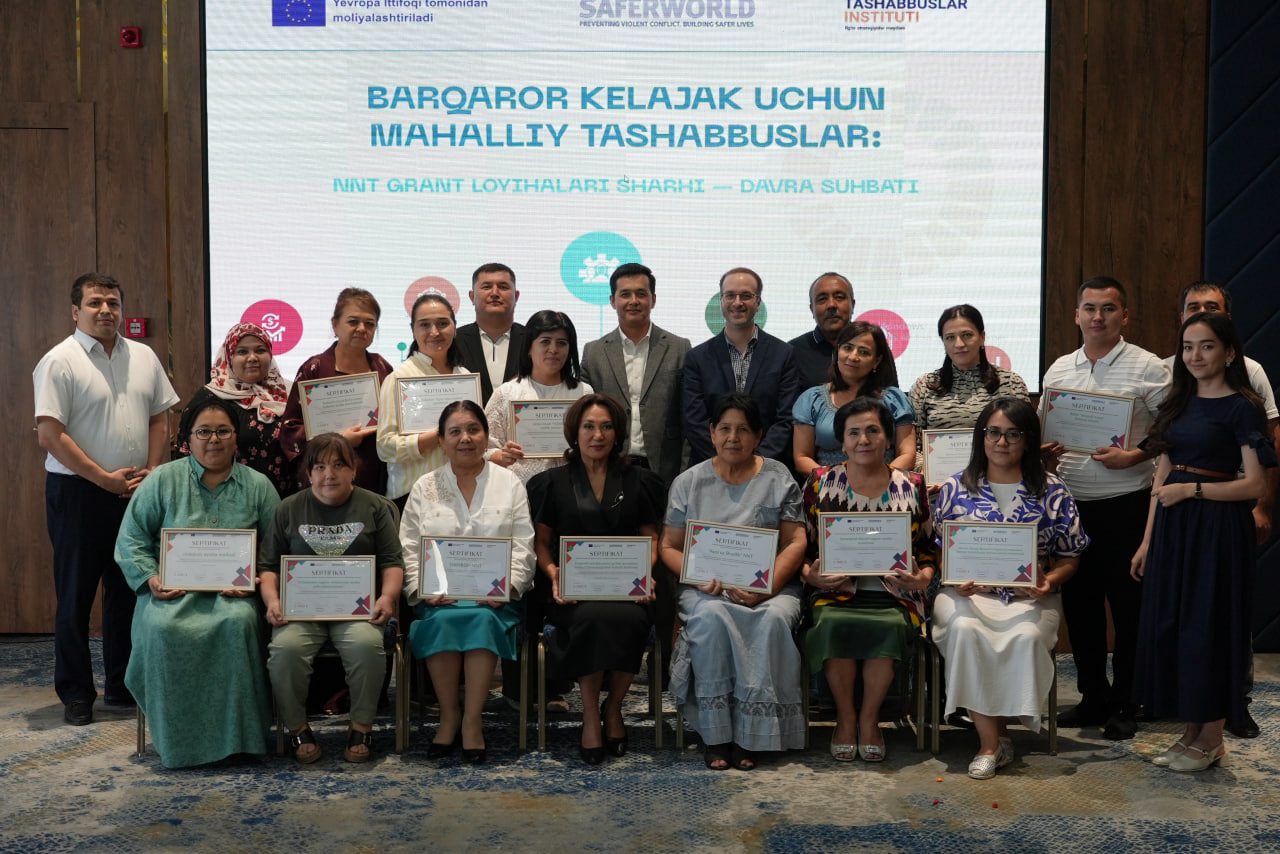
As part of Sustainable Development Goals Month, efforts are continuing to review the results of grant projects implemented in the regions, exchange experience, and strengthen cooperation between civil society institutions and government bodies.
To this end, a two-day roundtable entitled “Local Initiatives for a Sustainable Future: A Review of NGO Grant Projects” was held on 25–26 August 2026 at the Shamsan Hotel in Tashkent.
The event was organised jointly by the Institute for Social and Economic Initiatives, the international organisation Saferworld, and the European Union. It brought together representatives of non-governmental non-profit organisations that implemented grant projects in all 14 regions of the country, as well as international and local partner organisations.
The main purpose of the roundtable was to review the results of local initiatives implemented by NGOs in the regions, exchange accumulated experience and lessons learned during project implementation, identify existing systemic challenges, and develop proposals aimed at further strengthening cooperation between civil society institutions and government bodies.
On the first day of the event, local initiatives implemented in 14 regions and the results achieved within their framework were presented. NGO representatives provided information about their projects, the activities undertaken, and the practical results achieved.
During interactive group work, participants analysed the organisational, legal, financial, and local-level challenges encountered during project implementation. They shared their experiences, approaches, and practical solutions for overcoming existing obstacles.
A separate session reviewed successful practices and effective case studies developed in the regions and discussed the possibilities of applying them in other areas. Particular attention was paid to exchanging experience among NGOs, providing mutual support, and strengthening cooperation.
The second day of the roundtable focused on strengthening cooperation between NGOs and the public sector. Participants analysed systemic challenges arising in cooperation with government bodies at the regional and national levels and identified priority areas to be included in the agenda of future dialogue.
In particular, discussions focused on developing local infrastructure, strengthening social partnerships, ensuring the efficient allocation of resources, and establishing sustainable mechanisms for dialogue with government bodies.
During the small-group sessions, participants developed specific proposals and appeals for submission to government bodies, solutions to existing challenges, and supporting evidence. The views and proposals expressed were consolidated, and the formation of a common position among NGOs on key issues was discussed.
Participants also exchanged views on prospects for the development of civil society through 2030. The possibility of consolidating the relevant proposals and recommendations and submitting them to the Ministry of Justice of the Republic of Uzbekistan was considered.
At the conclusion of the two-day roundtable, proposals and recommendations were developed to disseminate the experience gained through grant projects implemented in the regions, expand cooperation networks among NGOs, strengthen dialogue between civil society institutions and government bodies, and systematically address existing challenges.
Press Service of the Institute for Social and Economic Initiatives