
Latest news

Institute news and events

Analysis of Time Spent by the Population on Social Media

Today, using social media and spending time on these platforms has become one of the main habits of our daily lives. This, in turn, has reached a point where it is changing our daily routines, values, and habits. The survey results also revealed other interesting aspects that we may not have previously considered and showed that there is a broader picture behind current trends in social media use. We are pleased to present the results of this study conducted by the Opinions Center for Sociological Research of the "Yuksalish" Movement in cooperation with the Institute for Social and Economic Initiatives. A total of 1,371 respondents from 14 regions of Uzbekistan took part in the social survey entitled “Life in the Age of Social Media.” The survey examined the purposes for which people use social media, the amount of time they spend on these platforms, and the impact of social media on study, work, and sleep. Platforms Used According to the responses, the most widely used platform is Telegram, selected by 88.9 percent of participants, or 1,219 respondents. It is followed by Instagram at 73.5 percent and YouTube at 61.8 percent. Meanwhile, 24.7 percent of participants, or 338 respondents, reported using Facebook. Purposes of Using Social Media According to the results, 69.9 percent of respondents, or 958 people, use social media to communicate with friends and family members. Following the news was selected by 64 percent, or 877 respondents; education by 43.8 percent, or 600 respondents; entertainment content by 42.2 percent, or 579 respondents; and income-generating and professional purposes by 40.6 percent, or 557 respondents. Participants were able to select more than one answer to this question. As the results above show, social media is not merely a space for entertainment. While most respondents use social networks as a source of information and a means of communication, a certain segment also uses social media as a source of income. Managing Our Time Starts with Ourselves In response to the question, “How much time per day do you spend on social media on work or study days?”, 37.3 percent of respondents, or 512 people, reported spending more than two hours per day on social media during work or study days. Another 12.4 percent, or 170 respondents, said they spend more than four hours per day on social media. On weekends, the share of respondents spending more than four hours on social networks rises to 19.7 percent, or 270 people. More than half of the participants, 57 percent, or 781 respondents, believe the amount of time they spend on social media is within a reasonable limit. However, 33.4 percent, or 458 people, meaning approximately one in every three respondents, admitted that they spend more time on social media than necessary. Among those who had tried to reduce the amount of time they spend on social media, 511 respondents, or 61 percent, succeeded, while 327 respondents, or 23.9 percent, were unable to do so. At the same time, 28 percent of respondents said they did not feel a need to reduce the amount of time they spend on social media. This Is Not Only a Problem for Young People When we talk about spending long periods of time on social media, we often tend to associate this habit mainly with young people. However, the employment groups represented in the survey revealed a different picture. For example, the share of respondents spending more than two hours per day on social media was 54 percent among pensioners and 43.7 percent among respondents engaged in household activities. Among school students, the figure stood at 27.3 percent, while among university students it was 32.7 percent. Significant Impact on Sleep and Daily Activities A total of 62.2 percent of survey participants, or 853 respondents, reported that social media use affects their sleep. Among respondents aged 18 and above, 58.1 percent stated that social media interferes with their work or daily responsibilities to some extent. Participants were able to choose several response options for this question. Among participants aged 13–17, 74.4 percent reported experiencing an impact on their sleep. Nearly three-quarters of respondents in this age group also said that social media interferes with their studies or homework. Among teenagers, 66.7 percent said that their parents constantly monitor their social media use, while 28.2 percent said their parents monitor it occasionally. Another 5.1 percent of teenagers reported that their parents do not monitor their social media use. Excessive Time Spent Online Causes the Greatest Concern The most frequently selected concern among respondents was excessive time spent on social media, cited by 30.1 percent, or 413 respondents. Another 18.6 percent, or 255 respondents, identified false or unreliable information as their main concern, while 13.2 percent, or 181 respondents, considered fraud and the exposure of personal data to be the most serious problems associated with social media use. Other respondents pointed to factors such as the impact on sleep and health, 6.9 percent; reduced communication among family members, 6.9 percent; and insults and harassment, 4.2 percent. Meanwhile, 8.5 percent of respondents believe that using social media does not cause any problems. Progress Begins with Everyday Habits The survey results indicate the need to strengthen responsibility among all segments of society when it comes to social media use. Organizations and authors producing content should not view audience attention solely as a means of increasing the number of views. They should increase the volume of high-quality content that contributes to national values, education, professional development, and healthy lifestyles. They should also help prevent the spread of false or unverified information and take particular responsibility for the content of materials intended for children and adolescents. Government agencies and organizations responsible for youth affairs, education, healthcare, and spiritual and educational development are advised to develop systematic programs aimed at promoting the conscious, safe, and moderate use of social media. Based on the results of the analysis, it can be concluded that awareness-raising and educational activities should target not only young people, but also the adult population. It would also be appropriate to introduce practical training sessions in educational institutions and mahallas on time management, media literacy, personal data protection, identifying false information, and, in particular, the conscious use of social media. Overall, the results of this analysis show that social media provides significant opportunities for gaining knowledge, communication, and professional development. At the same time, we also observed that uncontrolled social media use may result in inefficient use of time and have a negative impact on health and the performance of daily responsibilities. Therefore, the key task before us is not to restrict the use of social media, but rather to build a culture of using it consciously, safely, and with a clear purpose.  

Batafsil →
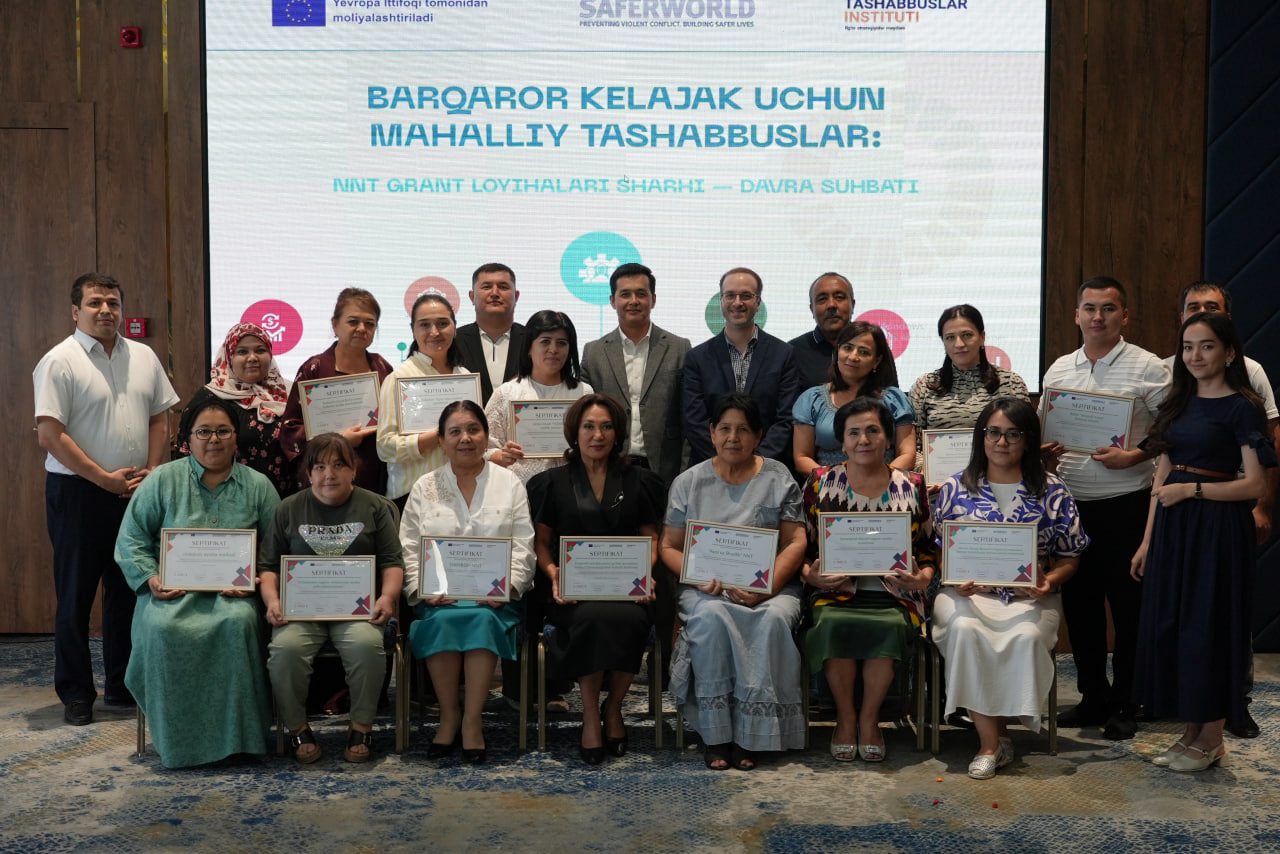
Local Initiatives for a Sustainable Future: Results of NGO Grant Projects Reviewed

As part of Sustainable Development Goals Month, efforts are continuing to review the results of grant projects implemented in the regions, exchange experience, and strengthen cooperation between civil society institutions and government bodies. To this end, a two-day roundtable entitled “Local Initiatives for a Sustainable Future: A Review of NGO Grant Projects” was held on 25–26 August 2026 at the Shamsan Hotel in Tashkent. The event was organised jointly by the Institute for Social and Economic Initiatives, the international organisation Saferworld, and the European Union. It brought together representatives of non-governmental non-profit organisations that implemented grant projects in all 14 regions of the country, as well as international and local partner organisations. The main purpose of the roundtable was to review the results of local initiatives implemented by NGOs in the regions, exchange accumulated experience and lessons learned during project implementation, identify existing systemic challenges, and develop proposals aimed at further strengthening cooperation between civil society institutions and government bodies. On the first day of the event, local initiatives implemented in 14 regions and the results achieved within their framework were presented. NGO representatives provided information about their projects, the activities undertaken, and the practical results achieved. During interactive group work, participants analysed the organisational, legal, financial, and local-level challenges encountered during project implementation. They shared their experiences, approaches, and practical solutions for overcoming existing obstacles. A separate session reviewed successful practices and effective case studies developed in the regions and discussed the possibilities of applying them in other areas. Particular attention was paid to exchanging experience among NGOs, providing mutual support, and strengthening cooperation. The second day of the roundtable focused on strengthening cooperation between NGOs and the public sector. Participants analysed systemic challenges arising in cooperation with government bodies at the regional and national levels and identified priority areas to be included in the agenda of future dialogue. In particular, discussions focused on developing local infrastructure, strengthening social partnerships, ensuring the efficient allocation of resources, and establishing sustainable mechanisms for dialogue with government bodies. During the small-group sessions, participants developed specific proposals and appeals for submission to government bodies, solutions to existing challenges, and supporting evidence. The views and proposals expressed were consolidated, and the formation of a common position among NGOs on key issues was discussed. Participants also exchanged views on prospects for the development of civil society through 2030. The possibility of consolidating the relevant proposals and recommendations and submitting them to the Ministry of Justice of the Republic of Uzbekistan was considered. At the conclusion of the two-day roundtable, proposals and recommendations were developed to disseminate the experience gained through grant projects implemented in the regions, expand cooperation networks among NGOs, strengthen dialogue between civil society institutions and government bodies, and systematically address existing challenges. Press Service of the Institute for Social and Economic Initiatives

Batafsil →

Hududlarda NNTlar bilan muloqotlar tashkil qilindi

Ijtimoiy-iqtisodiy tashabbuslar instituti va Yevropa Ittifoqi tomonidan moliyalashtirilgan "Saferworld" tashkiloti hamkorligida “O‘zbеkiston bo‘ylab Fuqarolik jamiyati tashkilotlarining (FJT) hozirgi ehtiyojlari, muammolari va salohiyatini aniqlash” dasturi doirasida respublikamizning turli hududlarida qator uchrashuvlar tashkil etildi. Xususan, Andijon, Samarqand, Buxoro, Sirdaryo, Surxondaryo va Xorazm NNTlari bilan o‘tkazilgan yig‘ilishlarda hududlarda fuqarolik institutini rivojlantirish bo‘yicha amalga oshirilayotgan ishlar, mavjud muammolar hamda ularning yechimlari bo‘yicha fikr almashildi. Takliflar yig‘ilib, kelgusidagi ishlar rejasi tuzib olindi.

Batafsil →

Mini-grant tanlovi natijalari e'lon qilindi

O‘zbekistonda fuqarolik jamiyati institutlarini qo‘llab-quvvatlash, nodavlat notijorat tashkilotlarining salohiyatini oshirish hamda davlat organlari bilan samarali hamkorlikni rivojlantirishga qaratilgan muhim loyiha doirasida mini-grantlar tanlovi yakunlandi. Mazkur loyiha Ijtimoiy va iqtisodiy tashabbuslar instituti tomonidan “Saferworld” xalqaro nodavlat tashkiloti hamkorligida hamda Yevropa Ittifoqining moliyaviy ko‘magida amalaga oshirilmoqda. Loyihaning asosiy мақсади — fuqarolik jamiyati tashkilotlarining institutsional va dasturiy imkoniyatlarini mustahkamlash, hududiy tashabbuslarni qo‘llab-quvvatlash va jamiyat hayotida NNTlarning faol ishtirokini kengaytirishdan iborat. Loyiha doirasida respublikaning barcha hududlarida seminar-treninglar tashkil etilib, yuzlab nodavlat notijorat tashkilotlari vakillari zamonaviy yondashuvlar, jamoatchilik nazorati, ijtimoiy loyihalarni boshqarish hamda fuqarolik faolligini oshirish yo‘nalishlarida bilim va ko‘nikmalarini mustahkamladi. Shuningdek, malakali trenerlar guruhi shakllantirildi. Mini-grantlar tanlovi esa loyiha doirasidagi eng muhim bosqichlardan biri bo‘ldi. Tanlovga O‘zbekistonning barcha hududlaridan 100 dan ortiq nodavlat notijorat tashkilotlari o‘zlarining dolzarb, innovatsion va ijtimoiy аҳамиятга ega loyihalari bilan иштирок etdi. Arizalar ekspertlar tomonidan sinchkovlik bilan baholanib, jamiyat rivojiga amaliy hissa qo‘sha oladigan eng munosib tashabbuslar saralab olindi. Tanlov g‘oliblari: HAMROH NNT — “Yashil maktab” loyihasi (Andijon viloyati) “Yuksalish” harakati hududiy bo‘linmasi — “Buxoro viloyatida 9 ta ijtimoiy-iqtisodiy sohada jamoatchilik nazoratini yanada kuchaytirish” (Buxoro viloyati) O‘zbekiston “Agrar soha ayollari” uyushmasi — “Men va mening huquqlarim” (Farg‘ona viloyati) “YETAKCHI” yoshlar markazi — “NNTlarni yangi zamonaviy usullardan foydalanib rivojlantirish” (Jizzax viloyati) Tadbirkor oila markazi — “Xotin-qizlar va yoshlarning himoya huquqi — bu adolat poydevoridir” (Namangan viloyati) Barqaror rivojlanish maqsadlari ijtimoiy tashabbuslar markazi — “Toza suv — umrga foyda” (Navoiy viloyati) Bolalar va oilalarni qo‘llab-quvvatlash assotsiatsiyasi — “Zo‘ravonliksiz oila — baxtli jamiyat” (Qashqadaryo viloyati) Fuqarolik tashabbuslarini qo‘llab-quvvatlash markazi — “Ayol taqdiri: sahna orqali muloqot” (Qoraqalpog‘iston Respublikasi) Nogiron ayollar uyushmasi Paxtachi tuman hududiy bo‘limi — “Adolat hamma uchun” (Samarqand viloyati) RIAM “Istiqbolli Avlod” — “Tenglik hududi: gender tengligini targ‘ib qilishda erkaklar va o‘g‘il bolalarning ishtirokini kuchaytirish” (Sirdaryo viloyati) “Ayol va Shodlik” NNT — “Imkoniyat va innovatsiya” (Surxondaryo viloyati) O‘zbekiston nogiron ishbilarmon ayollar milliy assotsiatsiyasi — “Inklyuziv raqamli olam” (Toshkent shahri) Tadbirkor ayollar assotsiatsiyasi (Bo‘ka tumani) — “Ijtimoiy tadbirkorlik” (Toshkent viloyati) “Istiqbol” ayollar markazi — “Himoya va istiqbol” (Xorazm viloyati) Mazkur tashabbuslar fuqarolik jamiyati institutlarining hududlardagi faolligini oshirish, aholining ijtimoiy himoyaga muhtoj qatlamlarini qo‘llab-quvvatlash, gender tengligi, ekologiya, inklyuziya, ijtimoiy tadbirkorlik va jamoatchilik nazorati kabi muhim yo‘nalishlarda amaliy natijalarga erishishga xizmat qiladi. Ijtimoiy va iqtisodiy tashabbuslar instituti barcha g‘oliblarni samimiy tabriklaydi hamda loyihalarni muvaffaqiyatli amalga oshirishda ularga ulkan zafarlar tilaydi. Ishonamizki, ushbu tashabbuslar jamiyatimiz taraqqiyoti, fuqarolik faolligini oshirish va hududlarni barqaror rivojlantirishga munosib hissa qo‘shadi. Ijtimoiy va iqtisodiy tashabbuslar instituti matbuot xizmati

Batafsil →

ОБЪЯВЛЕНИЕ: Конкурс мини-грантов для ННО

Институт инициатив в партнерстве с международной ННО «Saferworld» (Кыргызстан) при финансовой поддержке Европейского Союза реализует проект «Поддержка организаций гражданского общества в Республике Узбекистан». Общая цель проекта Укрепление потенциала организаций гражданского общества Узбекистана по взаимодействию с государственными органами, а также усиление их роли и вклада в содействие инклюзивному и устойчивому развитию страны путем интеграции их деятельности в национальные и региональные планы развития. Условия конкурса Участники: В конкурсе могут принимать участие ННО из всех регионов Узбекистана. Бюджет: Сумма проекта, представляемого на конкурс, не должна превышать 5 000 евро. Продолжительность: Проект должен длиться до 4 месяцев. Темы: Тематика конкурса не ограничена. Заявки принимаются в любой социально значимой сфере. Примерные направления (не ограничиваясь ими): Права человека и гендерное равенство: Защита прав женщин и детей, борьба с насилием, правовая и психологическая помощь уязвимым слоям населения. Инклюзивное развитие: Интеграция лиц с инвалидностью в общество, обеспечение их занятости и создание без барьерной среды. Экология и устойчивость: Решение экологических проблем в регионах, «зеленые» инициативы и повышение экологической культуры населения. Государственное и общественное строительство: Усиление участия общественности в процессах принятия решений совместно с местными органами власти, осуществление общественного контроля. Цифровая трансформация и инновации: Внедрение IT-технологий в деятельность ННО, использование инновационных подходов в решении социальных проблем. Социальное предпринимательство: Малые социальные проекты, направленные на повышение занятости населения, и создание центров профессионального обучения. Требования к участникам и документы: От одной ННО принимается только одна заявка. ННО не должны быть связаны с какими-либо политическими силами (партиями, движениями, лидерами и т.д.). Список документов: Заполненная заявка, копия свидетельства о регистрации, копия Устава и бюджет в формате Excel. В случае принятия положительного решения потребуются справка об отсутствии задолженности по налогам и банковский сертификат. Критерии оценки (100-балльная система): Все заявки проходят предварительную проверку на соответствие условиям конкурса, после чего оцениваются комиссией по следующим критериям: № Критерий оценки Баллы 1 Обоснованность связи между целями, задачами и ожидаемыми результатами проекта. Актуальность проблемы. 25 2 Участие и поддержка со стороны государственных органов, местного сообщества или других партнеров. 15 3 Использование в проекте новых методов, цифровых инструментов или нестандартных решений проблемы. 15 4 Стратегия информирования общественности о проекте и четкий охват целевых групп (бенефициаров). 15 5 Соответствие планируемых расходов рыночным ценам, их обоснованность и соблюдение лимита (5 000 евро). 15 6 Сохранение результатов проекта после окончания срока гранта и вероятность продолжения деятельности. 15 Порядок подачи заявок: Документы принимаются до 20 апреля 2026 года, 18:00 (ташкентское время) по электронной почте: info.iceinitiatives@gmail.com. По вопросам конкурса: +998 881192701.

Batafsil →